
Skip to content
Chase Post

Chase Post

Supreme Civic Chronicle

Primary Menu Chase Post

Chase Post

  • Technology
  • Home
  • Fashion
  • Education
  • Business
  • Automotive
  • About Us
    • Advertise Here
    • Contact Us
    • Privacy Policy
    • Sitemap
  • Home
  • This Porsche 911 Is an Automotive Unicorn Waiting for a New Stable
  • Car & Automotive

This Porsche 911 Is an Automotive Unicorn Waiting for a New Stable

Janelle B. Smith June 4, 2022

[ad_1]

From a distance, a Porsche 911 is like a penguin. All penguins look more or less alike, indistinguishable except to each particular penguin’s mate or mother. Similarly, Porsche’s familiar 911 shape blends in with others of its kind, and telling them apart is especially confusing to folks for whom “911” is not a religion. That’s because during the nearly 60-year life of the German marque’s iconic model, many hundreds of variants have emerged, each identified by series, year and specifications that weave a genealogy as complicated as Adam’s family tree.

Over-simplifying things a bit, the end of the line for the original version of the 911, introduced in 1964, came in 1989, when the series was replaced with the 964, a 911 that looked nearly identical to its predecessor but was 80 percent new under the skin. When it comes to what many consider the quintessential 911 Carrera, it’s the examples made just prior to the 964, those from 1987 through 1989. The Carrera used the uprated 3.2-liter flat-six engine that replaced the 911 SC’s 3.0-liter mill in 1984, and the upgrade carried the series through to 1989, when the 964’s 3.6-liter engine took over. Of the last “pure” 911 Carreras, the 3.2 Club Sport is, for many, the most desirable of them all.

More from Robb Report

The 1989 Porsche 911 Carrera 3.2 Club Sport, uniquely dressed in Linden Green, to be presented by Gooding & Company at Pebble Beach. - Credit: Brian Henniker, courtesy of Gooding & Company.

The 1989 Porsche 911 Carrera 3.2 Club Sport, uniquely dressed in Linden Green, to be presented by Gooding & Company at Pebble Beach. – Credit: Brian Henniker, courtesy of Gooding & Company.

Brian Henniker, courtesy of Gooding & Company.

Porsche customers seeking a hardcore, stripped-down 911 in the spirit of the original 1973 Carrera RS had been waiting for more than a decade when Porsche finally offered the Club Sport. Launched at the Frankfurt Motor Show in September of 1987, it was shown with the rest of Porsche’s 1988 model-year lineup. Available only in coupe form, it was a legitimate successor to the original RS, if a bit more civilized.

Only 340 examples of the Club Sport (option code M637) were built from 1987 to 1989. Most were painted Grand Prix White. A few other colors occasionally slipped through, and among those, a sole Club Sport was finished in metallic Paint-to-Sample (PTS) Linden Green, a color introduced by the factory in 1972. The Porsche community is rabid for PTS cars, and rare colors invariably bring a premium in the marketplace. Combining the M637 option with the Linden Green paint scheme makes this 1989 Club Sport a one-off among 911s, and it will soon be available through Gooding & Company at its annual Pebble Beach auction on August 19 and 20.

Porsche claimed an output of 214 hp for the Club Sport’s 3.2-liter flat-six engine, though it actually developed more like 240 hp. - Credit: Brian Henniker, courtesy of Gooding & Company.

Porsche claimed an output of 214 hp for the Club Sport’s 3.2-liter flat-six engine, though it actually developed more like 240 hp. – Credit: Brian Henniker, courtesy of Gooding & Company.

Brian Henniker, courtesy of Gooding & Company.

Porsche connoisseurs obsessed with details appreciate the differences between the 911 Carrera Club Sport and a “civilian” Carrera. With the Club Sport, weight was conserved at every turn, and so the CS wears minimal PVC underseal. Consequently, Porsche’s good-faith, ten-year anti-corrosion warranty was reduced to just two years. Bilstein shocks, optionally available on the Carrera, came standard, along with ventilated disc brakes and an 80-liter (21.1-gallon) fuel tank. And the spare wheel was aluminum instead of steel. The 911’s beautiful Fuchs forged alloy wheels were painted body color by the factory on this example.

Officially, the Club Sport engine is identical to that of other European-spec Carreras, but it uses hollow intake valves, a modified air intake and re-mapped engine management that allows revs to reach 6,850 rpm. The Getrag G50 gearbox has taller ratios in fourth and fifth gears, while a single-plate clutch and a limited-slip differential, optional on the 911 Carrera, were also standard. Though the factory claimed 214 hp, Club Sport engines developed more like 240 hp. The CS was plenty quick for its time, firing off zero-to-62 mph in about 5.4 seconds—only bettered by the 911 Turbo—while its top speed is 156 mph.

Top speed for the Carrera 3.2 Club Sport is 156 mph. - Credit: Brian Henniker, courtesy of Gooding & Company.

Top speed for the Carrera 3.2 Club Sport is 156 mph. – Credit: Brian Henniker, courtesy of Gooding & Company.

Brian Henniker, courtesy of Gooding & Company.

The interior of this CS is a minimalist’s delight, judiciously lightened at the factory by deleting the rear seats, most of the sound insulation and even lightening the wiring loom, since luxuries like power windows, central locking and a radio were deleted, as were the lights for the engine lid and luggage compartment.

Because ounces add up to pounds, armrests and the passenger’s sun visor went missing. After its starvation diet, the car officially weighs in about 150 pounds lighter than the standard 911 Carrera. Notably, the CS models were equipped with Sports seats, most of which featured snazzy upholstery in black pinstripe fabric with red piping. This Linden Green Club Sport was ordered with Porsche’s “Celebration” two-tone cloth upholstery in black and gray, a time-capsule fashion statement, and unrepeatable today.
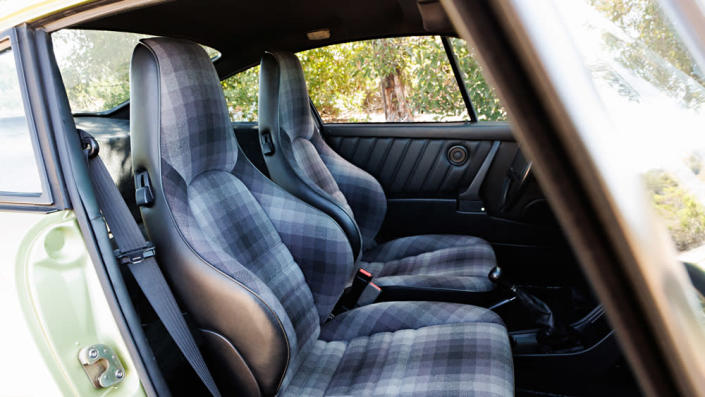
Porsche’s bygone “Celebration” upholstery, a two-tone cloth treatment in black and gray, adds to the exclusivity. - Credit: Brian Henniker, courtesy of Gooding & Company.

Porsche’s bygone “Celebration” upholstery, a two-tone cloth treatment in black and gray, adds to the exclusivity. – Credit: Brian Henniker, courtesy of Gooding & Company.

Brian Henniker, courtesy of Gooding & Company.

Built for the German market, this car later went to Japanese and Belgian collections before being imported into the US by the current owner. With 47,758 km (29,675 miles) on the odometer, and supplied with books, tools, a spare, accessories and Porsche COA and documentation, this unicorn Club Sport is expected to fetch as much as $500,000.

Best of Robb Report

Sign up for Robb Report’s Newsletter. For the latest news, follow us on Facebook, Twitter, and Instagram.

Click here to read the full article.

[ad_2]

Source link

Post navigation

Previous: Watch Now: Northern Trust wins Diversity, Equality and Inclusion Award at Business & Finance Awards – Business & Finance
Next: Don’t Forget About The Work Opportunity Tax Credit!

More Stories

Decoding the Soul of Speed: A Mechanic’s Dissection of the 2024 BMW M5 Competition—Where Precision Engineering Meets the Edge of Human Performance
  • Car & Automotive

Decoding the Soul of Speed: A Mechanic’s Dissection of the 2024 BMW M5 Competition—Where Precision Engineering Meets the Edge of Human Performance

Janelle B. Smith October 14, 2026
The 2024 BMW M5 Competition’s Radical Redesign: A Dissection of How Its Revamped Chassis, Hyper-Efficient Twin-Turbo V8, and Adaptive Aero Redefine the Sport Sedan Benchmark
  • Car & Automotive

The 2024 BMW M5 Competition’s Radical Redesign: A Dissection of How Its Revamped Chassis, Hyper-Efficient Twin-Turbo V8, and Adaptive Aero Redefine the Sport Sedan Benchmark

Janelle B. Smith October 12, 2026
The 15-Minute Daily Checklist for Spotting Hidden Issues Before They Turn Into Costly Repairs: A Mechanic’s No-Nonsense Routine for Long-Term Vehicle Reliability
  • Car & Automotive

The 15-Minute Daily Checklist for Spotting Hidden Issues Before They Turn Into Costly Repairs: A Mechanic’s No-Nonsense Routine for Long-Term Vehicle Reliability

Janelle B. Smith October 10, 2026

Categories

  • Beauty
  • Business & Finance
  • Car & Automotive
  • Computer & Technology
  • Fashion & Shopping
  • Food & Cooking
  • General
  • Health
  • Health & Fitness
  • Home & Improvement
  • Latest News Place
  • Law & Legal
  • Science & Education
  • Travel & Leisure

Archives

Recent Posts

  • The Science-Backed Art of Recovery: How Strategic Micro-Rest, Adaptogenic Blends, and Sleep Architecture Can Rewire Your Nervous System for Sustainable Wellness (Beyond the Hype)
  • How Deep Work Principles, Cognitive Load Theory, and the Pomodoro Technique Intersect to Redefine Focus in the Digital Age: A Neuroscience-Backed, Step-by-Step Framework for Sustainable Productivity
  • From Pantry to Plate: 15 No-Fuss Meal Ideas Using Common Staples—With Exact Prep Times and Budget Breakdowns
  • The 2024 Rise of Slow Luxury in Streetwear: How Sustainable Materials, Handcrafted Details, and Digital Minimalism Are Redefining Urban Fashion’s Most Exclusive Subcultures
  • From Silicon Chips to Liquid Cooling: A Deep Dive Into the Hidden Layers of Modern Computer Hardware—How Every Component Shapes Performance, Power Efficiency, and Future-Proofing

BL

You may have missed

The Science-Backed Art of Recovery: How Strategic Micro-Rest, Adaptogenic Blends, and Sleep Architecture Can Rewire Your Nervous System for Sustainable Wellness (Beyond the Hype)
  • Health & Fitness

The Science-Backed Art of Recovery: How Strategic Micro-Rest, Adaptogenic Blends, and Sleep Architecture Can Rewire Your Nervous System for Sustainable Wellness (Beyond the Hype)

Janelle B. Smith October 14, 2026
How Deep Work Principles, Cognitive Load Theory, and the Pomodoro Technique Intersect to Redefine Focus in the Digital Age: A Neuroscience-Backed, Step-by-Step Framework for Sustainable Productivity
  • General

How Deep Work Principles, Cognitive Load Theory, and the Pomodoro Technique Intersect to Redefine Focus in the Digital Age: A Neuroscience-Backed, Step-by-Step Framework for Sustainable Productivity

Janelle B. Smith October 14, 2026
From Pantry to Plate: 15 No-Fuss Meal Ideas Using Common Staples—With Exact Prep Times and Budget Breakdowns
  • Food & Cooking

From Pantry to Plate: 15 No-Fuss Meal Ideas Using Common Staples—With Exact Prep Times and Budget Breakdowns

Janelle B. Smith October 14, 2026
The 2024 Rise of Slow Luxury in Streetwear: How Sustainable Materials, Handcrafted Details, and Digital Minimalism Are Redefining Urban Fashion’s Most Exclusive Subcultures
  • Fashion & Shopping

The 2024 Rise of Slow Luxury in Streetwear: How Sustainable Materials, Handcrafted Details, and Digital Minimalism Are Redefining Urban Fashion’s Most Exclusive Subcultures

Janelle B. Smith October 14, 2026
From Silicon Chips to Liquid Cooling: A Deep Dive Into the Hidden Layers of Modern Computer Hardware—How Every Component Shapes Performance, Power Efficiency, and Future-Proofing
  • Computer & Technology

From Silicon Chips to Liquid Cooling: A Deep Dive Into the Hidden Layers of Modern Computer Hardware—How Every Component Shapes Performance, Power Efficiency, and Future-Proofing

Janelle B. Smith October 14, 2026
chasepost.net | CoverNews by AF themes.

WhatsApp us