
A Renowned Concept Car Designer Weighs in on Our Automotive Future
[ad_1]
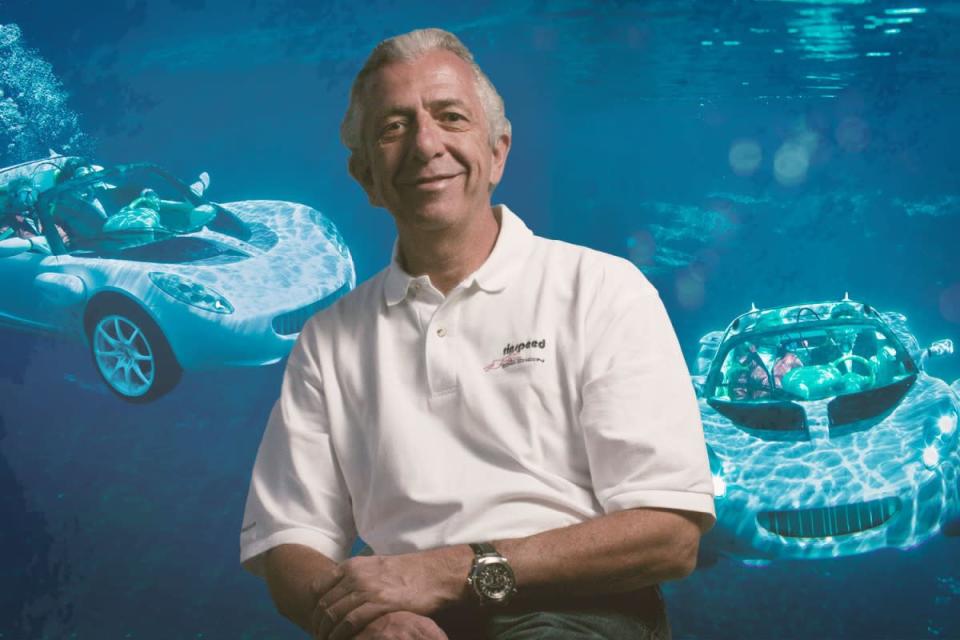
Frank Rinderknecht isn’t sure about being called a car designer.
“We’re more of a think tank for mobility issues,” he tells InsideHook. “We just try to push new ideas, but it’s important for me to make them really happen, and not just exist in PowerPoint. You have to be able to touch the object. You can’t radiate a new idea from a piece of paper.”
That’s why the Switzerland-based Rinderknecht — who started out importing these strange new things called sunroofs back in the 1970s, before launching Rinspeed, which began as a massively successful Porsche tuning company — has poured a lot of the money he’s made into producing dozens of concept cars. And that’s high concept. Over the last 30 years he has designed, engineered and built vehicles like the Presto, a car that extends and contracts on demand, and the UC, an ultra-compact electric two-seater with drive-by-wire joystick control.
A lot of his ideas predate societal shifts in our transportation requirements. His Bedouin was the first natural-gas-powered car, his Advantige Rone the first supercar powered by kitchen waste biofuel. But Rinderknecht’s reputation for making the crazy into someting real sometimes gets in the way of his real contribution to said mobility issues. Perhaps his best-known concept car is the “sQuba.” It’s a fully submersible car, providing occupants are wearing scuba gear.
It’s true that even the most dedicated of car nuts may not have heard of Rinderknecht, but plenty of his ideas have been borrowed by the wider auto industry. Matte paint and nanotech coatings, scratch-proof polycarbonate windshields, biometric driver monitoring, in-car connectivity, mounting controls on the steering wheel — Rinderknecht did them first. The latter idea would have made Rinderknecht a fortune if international patenting law had been less circumventable.
“Our approach at Rinspeed is not about making things a little bit better here or there,” Rinderknecht explains. “We try to think in terms of revolution, not evolution, and for that you need a loose mind and, yes, a little shot of craziness — though a lot of blood, sweat and tears goes into making these ideas real. Of course sometimes people still shake their heads and say, ‘What the hell is he doing now?’ And yet the CEO of every big car company comes to our booth at the car shows.”
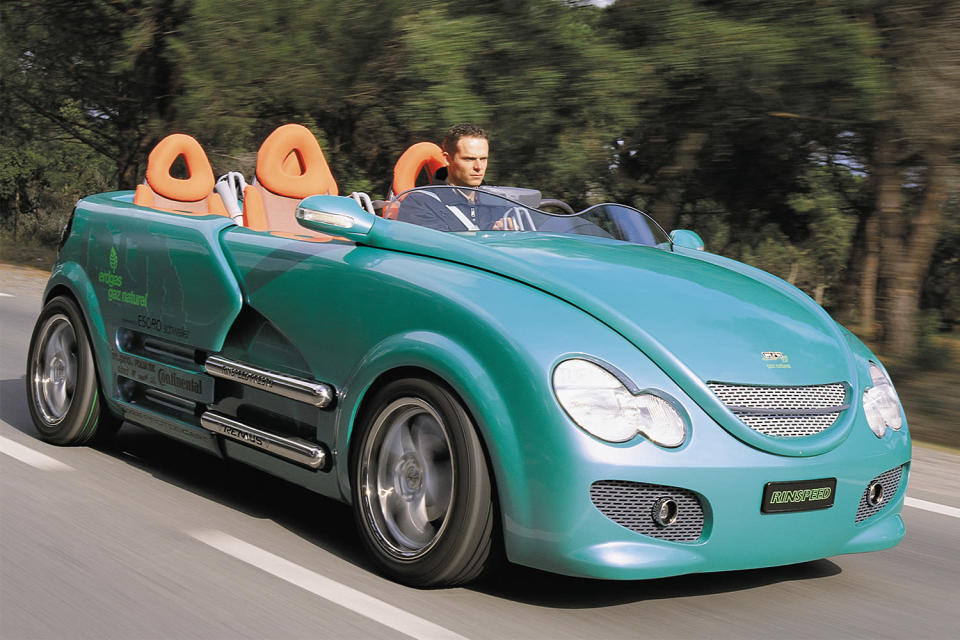
The Presto, which can stretch on command.
Rinspeed
Indeed, Rinspeed’s cars tend to be unveiled more at consumer electronics shows than car shows these days. That’s in keeping with what Rinderknecht feels to be the former industry’s progressive try-anything attitude, and because his concept cars, and the new ideas they embody, tend to come out of partnerships with the likes of cutting-edge developers in, say, materials science, that historically have had no connections with the car world but want to showcase their products.
This helps keep costs down, but it’s also indicative, he reckons, of how we’re likely to think of vehicles in the future: more as tools or devices. Some of the big car companies are, as he puts it, already seeing that the winds of change will shift away from sheet metal and more towards data management, but they’re a long way behind the likes of Google.
“Compare the progressiveness of the consumer electronics world to that of, say, German carmakers, which are mostly still engineering-driven, focused on offering drivers a seat with 85 positions when nobody needs them,” chuckles Rinderknecht. “Too many of these big car companies have a mindset that’s afraid of change. That’s why the few smaller companies entering the market, like Tesla, seem so disruptive, because they’re still able to act on gut. That’s important because the pace of change in the mobility sector is only going to get faster.”
More Like This
Small wonder then that eyes tend to be on what Frank does next, and that’s not just his turning his concepts into NFTs. His next mobility project is called CitySnap, which is exploring the idea of modular, click-together vehicles. His idea is for a platform — or “skateboard,” complete with the powertrain, batteries, electronics and so on — onto which is fixed an interchangeable body, be that of a car or a truck, providing the kind of flexibility that drivers increasingly demand of their vehicles in the 21st century (hence the inexorable rise of the SUV).

The fourth generation of Rinspeed’s CitySnap modular vehicle.
Rinspeed
A pilot production program will launch later this year — the first Rinspeed concept to go into production — and the idea is already being pondered by inner-city logistics companies, for which, Rinderknecht argues, all kinds of efficiencies are possible, especially given the pandemic boom in having stuff delivered. But this type of construction also makes sense, he argues, because cars are so packed with electronics these days, the pace of change being such that they’re out of date before they’ve left the lot, and certainly long before the bodywork of a car needs replacing.
“Just how long is a driver willing to put up with old software? Maybe five years? And he can’t even upgrade it because the electronics are so pervasive throughout any new car now,” he argues. “One of the biggest problems facing the industry is the lifespan of its products. You used to be able to get 20 years and 250,000 miles out of a car. Now the smarter they get, the shorter their lifespan, unless we make changes. The fact is that we have to think differently about mobility. Nobody knows what our mobility needs will be in decades to come, thanks to changes in society, technology, the environment. Of course, when we first started talking about a system that allowed major parts of a vehicle to be swapped, which is an idea borrowed from aviation, plenty of people said, ‘Here we go again, it’s Crazy Frank.’”
More Like This
“But it’s clear that we can’t go on as we are. It makes no sense to have personal vehicles which for 70% of their lifespans are just sat on the street unused and getting old, or when 80% of car journeys are less than 40 miles. That’s poison to the economics of mobility,” he adds. “And we have to remember that attitudes to cars are changing rapidly too. It would be fascinating to see, say in 30 years time, how we look back on cars — as these evil, polluting objects, or as a cultural good. My appreciation for cars makes me part of a dying breed. Ask young urban people like my daughter now and most don’t own a car and most don’t want to. They’re just more rational about cars. To them they’re a means of transport. ”

The iconic sQuba, possibly the vehicle Rinderknecht is best known for.
Rinspeed
It’s because of that shift — and the advent of autonomous cars, although he reckons it will be decades of incremental advances before such an “ultra-complex, ultra-expensive, ultra-demanding idea” goes mainstream — that Rinderknecht is convinced cars as we’ve known and loved them are on their way out. That, and because autonomous cars will be so expensive, owning one won’t make any sense for most people. As he points out, you may put off upgrading a car if you’re still behind the steering wheel, but if you’re trusting your life and that of your family to the machine you’re all sitting in, you’re going to want that machine to be up to date all the time.
And that’s a vehicle that runs on a purpose-built surface, stable on four wheels. Imagine the demands that would be required of a car that flew. That’s precisely why, and he’s asked often enough, Rinspeed has yet to make a car with wings — if you don’t count the Splash, which had hydrofoils.
“I just don’t think that a flying car is realistic, and the ones that are coming through now aren’t really cars as I think of them. They’re odd things that have to serve two masters and don’t pull it off, so you end up with something that flies but which is too fragile to be properly used as a car,” says Rinderknecht. “It’s great how playful these ideas are, but they’re not realistic. Sure, I love a concept. But there’s always a credibility and a seriousness to what we do.”
More Like This
This article was featured in the InsideHook newsletter. Sign up now.
The post A Renowned Concept Car Designer Weighs in on Our Automotive Future appeared first on InsideHook.
The article A Renowned Concept Car Designer Weighs in on Our Automotive Future by Josh Sims was originally published on InsideHook.
[ad_2]
Source link


